


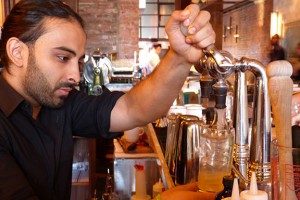
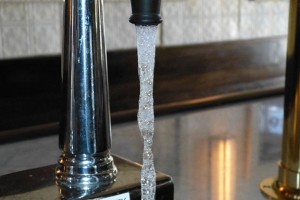
A Beuchert?s Saloon employee pours bright orange syrup into a glass, adds ice, and pulls the handle to a soda fountain draft releasing a stream of carbonated water. The result is a house-made orange crush soda.
?It?s very creamy,? said Rachael Lopez, 24, a patron at Beuchert?s. Her husband, Ben Berkow, 26, enjoyed the smooth taste and the subtle vanilla flavor he got.
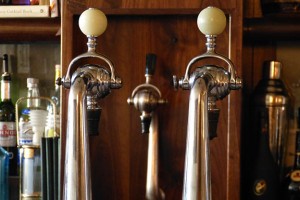
This new Capitol Hill restaurant recently installed three soda fountain draft arms originally assembled by the Liquid Carbonic Manufacturing Company and dated somewhere between the late 1880s and the mid 1910s.
August Paro, 45, is one of the saloon?s three owners and procured the equipment more than a year ago from a collector he?d found on eBay.
After a few emails and phone calls, Paro got what he was looking for and began working with his partners figuring out how to install the pieces in their new restaurant.
?I absolutely love the fact that there?s a soda resurgence going on in the country now. That?s incredible,? said Paro, varnishing a new shelf he?d just built for the bar.
At Beuchert?s, one arm pours soda water. Another pours filtered water. The last pours Prosecco.
Two of the arms are donned with ball handles made of white onyx. The brass arms are coated in thick chrome which, Paro says, is most likely the original casting.
The Prosecco arm has a sleek ?swan?s neck? design. The other two arms have a classic form most familiar to those who?ve been to the limited number of throwback ?soda jerk? shops left in the country.
The bartender makes another orange crush and carefully throttles back the soda water stream, unsure of its threshold. It?s been a long time since someone?s used one of these fountains.
?You can put fresh gaskets in them and they work exactly the way they worked in, say, 1905. I mean those are really nice pieces,? Paro said.
When Liquid Carbonic manufactured soda fountains they were cutting-edge equipment. Jacob Baur, a pharmacist in Terre Haute, Indiana, founded Liquid Carbonic in 1888.
Terre Haute is a town plucked right out of a Norman Rockwell painting and is home to the famous ?Crossroads of America? at the intersection of Seventh Street and Wabash.
According to Mike McCormick, contributor to the Tribune-Star newspaper and Terre Haute historian, several Baur descendants still reside in the town today although their involvement in their great relative?s soda fountain history appears minimal.
Baur?s soda fountain manufacturing company flourished for several decades after it had been established, eventually pivoting to other needs within the soft drink industry.
Ebbe Almqvist?s History of Industrial Gases?explains that Liquid Carbonic sold Coca-Cola Bottling Company the first low-pressure, carbonated beverage bottle filling system just weeks before World War I broke out.
Coca-Cola?s archives, however, were unable to confirm a business relationship between the two companies.
Most Americans would find little connection between the concoctions crafted in pharmacies before the 20th century and the ubiquitous soft drinks of today. Yet, the beginnings of the soda industry reside there.
According to Darcy O?Neil, booze blogger and author of Fix the Pumps, ?The belief that carbonated water was medicinal put it squarely in the hands of the medical profession and their whims… at first, [pharmacists] used the sweetened soda water to conceal the taste of bitter drugs like quinine and iron. Then they started to add more exotic substances.?
Some of those exotic substances gave 19th century customers the jolt they wanted by serving up cocaine laced, cola flavored drinks while ostensibly imparting medicinal benefits.
In fact, writes O?Neil, pharmacies were so popular at one point they rivaled taverns and saloons with their beverages.
Government regulations and pressure from temperance organizations over time helped strip the harder narcotics from these drinks. Still, the American appetite for sugary, carbonated beverages remained.
Today, several innovative bars and restaurants are looking to revive a little of the innocent craftsmanship that went into the original hand-made sodas.
Reviving a craft takes the best tools and equipment.
Paro, who?s collected a half-dozen arms himself, worked with Phil Schy, owner of American Soda Fountain, Inc., to restore Beuchert?s pieces.
American Soda Fountain, based in Chicago, has been in Schy?s family for three generations and leads the industry in refurbishing old soda fountain equipment. Paro and company have maintained a working relationship since beginning the project.
?It?s not about dollars. It?s about seeing things go to good use,? said Paro.
He?s looking forward to featuring his other soda fountain treasures in other spaces sometime in the near future.
?Soda arms do no good sitting in somebody?s basement,? Paro said.
Full disclosure: Anthony Rivera is currently an employee at Beuchert’s Saloon. He wrote this piece individually and as an intellectual endeavor. Scofflaw’s Den receives no financial benefits from Beuchert’s Saloon for this article.