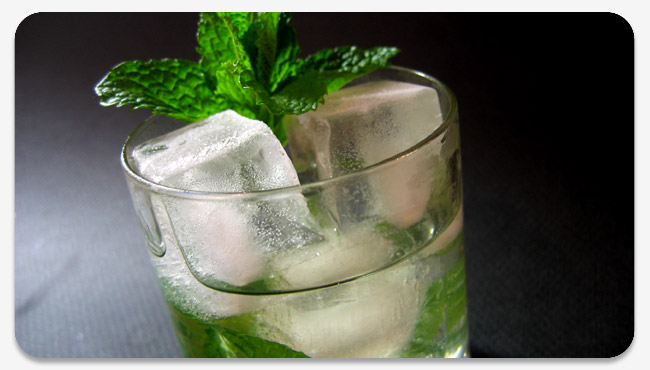
Bourbon…brownest of the brown liquors…so tempting…
First a disclaimer: IANAL – I Am Not A Lawyer.
I mean, I’m freakin’ SURROUNDED by them around here in the DC area, folks like…my brother. My co-blogger. Friends. Coworkers. Cocktailians.
But that doesn’t mean I know anything.
However, I shall go on anyways, because that’s what we bloggers do. And hey, a little controversy never hurt anyone, did it? (It did? Oh.)
There were three events that caused me to want to write this post. First, a certain small start-up syrups company had to change their name. Second, a bar in New York was forced to change their name (and see if you can see the thematic similarity between the two!). Third, while visiting a local bar with a solid cocktail program, a short conversation between a tourist and the bartender forced me to rethink my opinions on this topic.
INCIDENT ONE: TRADER TIKI SYRUPS BECOMES B. G. REYNOLDS’ EXOTIC SYRUPS.
On June 8th, Blair “Trader Tiki” Reynolds announced that he was changing the name of his company to B. G. Reynolds’ Exotic Syrups – and he changed the URL of his site as well. There wasn’t a huge online uproar about this.
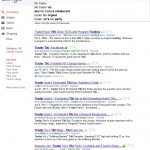
Google results for "tiki trader"
Quick disclaimer: I’ve known Blair for quite a while and consider him a friend.
He wouldn’t say who caused this to happen, though for some of us it was pretty to easy to figure out. Heck, start doing a Google Instant search for “tiki trader” and look at what you get – or look to the side here and see what I got.
If you know anything about these kind of things, you know that brands have to protect themselves. If they fail to go after people with similar names, they can lose the protection on their name. Therefore, when a company with a very similar name is also selling syrups, you know they’re going to want to protect themselves. From my understanding, there were discussions on it, but it’s just a question a lot of times of who has deeper pockets.
According to Rumdood, Blair was “neither bitter nor angry” at what happened. On the other hand, he points out that they haven’t (as far as one can tell) gone after Disney for having “Trader Sam’s Tiki Bar” and theorizes it’s because Disney has a bigger law budget.
I’m sure that doesn’t hurt, but there’s something else, too: as far as I can tell online, it’s not selling syrups online. Therefore, Trader Sam’s becomes advertising for Trader Vic’s and not competition.
Let me put this straight out there though: I own all of the B. G. Reynolds’ syrups, save one, and they’re all fantastic. Yes, Blair is a friend of mine, but I wouldn’t hesitate to recommend them to anyone. I’ve even bought a number of extra bottles for friends and relatives! Go out there and buy some!

TRUST THIS MAN
Besides, how can you not trust that smiling face?
GIVE HIM ?YOUR MONEYS!
Ahem, sorry about that. Let’s look at incident number the second.
INCIDENT TWO: DUE TO LAWSUIT, PAINKILLER BAR IN NYC BECOMES PKNY.
PKNY
Disclaimer: I don’t know anybody, really, from PKNY, except over Facebook, and haven’t been to their bar.
From what I understand and have read, this is what happened in a chronological order starting back in 1971. From Off The Presses, according to Beachbum Berry, the Painkiller was created in a bar in 1971 called the Soggy Dollar. Back then, it used Cruzan and Mount Gay rums.
In 1979, Pusser’s Rum was founded. From the founder’s statement, he got permission from the owner of the Soggy Dollar bar to trademark the Painkiller approximately 25 years ago. Approximately 8 years ago, they started work on a ready-to-drink Painkiller and have trademarks on both an alcoholic and non-alcoholic version.
Around a year ago, the bar then known as Painkiller opened in NYC. The owner of Pusser’s claim he contacted them “more than 10 times”. They didn’t respond, and so he sued, claiming they were causing irreparable harm to his brand. The court upheld that and PKNY lost their name and domain.
This caused a huge uproar amongst bartenders, cocktailians, tiki fanatics, and various other folks.
INCIDENT THREE: A TOURIST DESIRES A GIANT FROZEN DAIQUIRI.
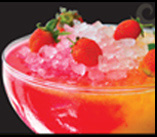
Giant Daiquiri from Hard Rock Hotel
Recently I was up at Liberty Tavern in Clarendon (a neighborhood here in Arlington). Liberty has a good cocktail program – I wouldn’t say it’s the most innovative, but they have a good liquor variety and make solid versions of classic cocktails.
While chatting with my bartender (who is also a friend of mine) a tourist wandered up to the bar. He was curious if they sold giant frozen daiquiris, like you get in certain places – often infused with lots of cheap juice and/or high fructose corn syrup, rum (if you’re lucky) or even just grain alcohol (if you’re on Bourbon Street), these are usually fruity, extremely sweet concoctions that bear almost no relation to the classic daiquiri.
The bartender offered him a classic daiquiri so he inquired after a frozen margarita. After she politely pointed out that they don’t make any frozen drinks, he agreed to try a classic margarita – a drink that he couldn’t drink at all.
I had a realization: he thought he knew what he wanted. He wanted what he’d gotten in a number of places before. Meanwhile, the bartenders and I knew what those drinks SHOULD be. Sure, it was partly that he came into the wrong bar to order a drink like that, and the bartender did redirect him to one that would help him better (and didn’t charge him for the margarita); however, because anyone can make a drink and call it a “daiquiri”, a “margarita”, or a “martini” (to add that one in there) we’ve come to a point where people don’t know what they’re ordering.
ANALYZING WHAT THE DIFFERENCE IS.
You might not realize it, but analysis is a combination of various words that basically mean “pulling lies out of your ass”.
Well, maybe not, but remember: IANAL. These are my opinions.
A couple of months ago, a friend of mine commented on the “Classic Cocktails” menu at a restaurant I’d visited, most of which involved “martini” or “margarita” variants. I distractedly responded that “well, it’s more of a beer joint” and he pointed out: “It’s just that terming these ‘Classic Cocktails’ is what we are fighting against.”
At first, I thought, “Fighting against? What am I fighting against? I just want folks to enjoy good drinks!”
And then incident three happened.
And I started thinking.
So…MY THOUGHTS:
A tradermark, in and of itself, is not a bad thing, nor is defending it.
I can’t be mad at Trader Vic’s for forcing the name change. They had a trademark and they had to defend it. I’m not privy as to HOW they went about that, what was claimed, etc., so I can’t say, but from an outsider’s point of view, I feel bad for Blair, but life is going on.
However, that’s more of a brand name, and not a cocktail. Let’s look at cocktails.
The trademarking of a cocktail is intended to protect the consumer – to make sure that when they order the drink, it will taste the way they expect.
This is Pusser’s argument. I think that is important in a cocktail, it should taste as you expect. However, I’m going to break this down a bit more.
If you did not create the cocktail, you should not trademark it.
Period. I don’t care that they have permission. Gosling’s gets away with it on the Dark & Stormy because supposedly it was created by them, but that not only points out the fact that Pusser’s recommended violating their trademark by using Pusser’s in a Dark & Stormy, but also my next point. Basically, in my opinion, there is no reason or excuse why Pusser’s should have that trademark.
A trademarked cocktail should not use specific brands. It should be trademarked by an individual.
This is a bit hazy, I will concede. Some specifics you can’t avoid – say, like Benedictine, or Chartreuse. However, when using rums, or whiskeys, or what have you, yes, there are slight differences, but the recipe should be generalized. It is not a religion. Recipes do not specify what brand of sugar or meat you should use.
If you’re serving a trademarked cocktail, you should give credit.
Honestly, in my opinion, if you know the origin of a cocktail, it should be credited. If you change it, it should be listed. “This is a variant of Mister Smith’s XYZ drink, but we use rum instead of poison.”
You should defend your trademark – when it is being abused.
Trader Vic’s probably does not sue Disney for Trader Sam’s because, in essence, they are advertising for them. Pusser’s should not have sued PKNY because, honestly, they were advertising the drink! If someone went home from PKNY and said “Man, I want a Painkiller now,” they’re going to look it up online or in a book. If you own the trademark on it, it should show up with your brand in it.
You should be clear and upfront with the public when defending ?your trademark.
You should be engaged in the social media game. At worst, you should just make sure your statement is public: “We do not want to have to pursue legal action, but we are defending our trademark because of X, Y, and Z reasons.” Being silent until it’s all over just makes you the bad guy automatically.
You should only trademark when you can prove no one did it before you. You should only get mad if you can prove no one came up with it independently.
It can be very easy or very hard to come up with a recipe based off watching someone make a drink. A single idea, especially if it’s to a mass audience, can cause a number of people to have the same thoughts on creating a new drink.
If you want to trademark your drink, and you’ve found that no one has made it before, that is the only time you should be able to do so – and it should be done PROMPTLY. In my opinion, that means in this day and age in VERY LITTLE TIME – like weeks, or less. And you should check with cocktail historians (at the BARE MINIMUM, check their books) and search the Internet for similar drinks.
If you DO trademark your drink (or even if you don’t, you’re just very proud of it) you should NOT get mad at someone for having a similar or even same drink unless you can without a doubt prove that they are purposely stealing it from you. It’s easy to come up with a drink that uses similar ingredients, even if you’re doing some infusing or making something custom – especially if you’re basing it off the same inspiration. Perhaps I’m being a bit naive, but I think it’s better to talk to the other folks involved and find out the genesis of their drink.
I kind of feel like I’m talking in circles by this point so I’m going to lay off. Basically, what I think is: you should only trademark if a drink is definitely yours, but at the same time, that trademark can protect the customers. The power that a trademark gives you should only be used sanely and carefully however.
What do you think?