Really, it all started, as so many things in my life do, with me running my mouth.

Me after the Super Bowl
You see, I figured that no matter who won the NFC, it wouldn’t matter – the AFC team was going to win the Super Bowl. And, of course, I thought that even more when my favorite team (the Pittsburgh Steelers) looked like they were going to make it. In fact, I was so confident I said I’d post about vodka – the oft-derided liquor of many cocktailians – if the NFC games that weekend mattered.
Well…damn.
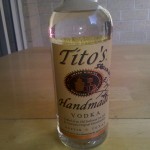
I also received two bottles of Tito’s Vodka in the mail. I’d never had it before though I’d seen good things about it. A lot of people will argue that all vodkas taste the same, or that they should all be “flavorless”, but that’s really just not the case. I’d argue that some of that might have come from the Smirnoff and other advertising campaigns of the ’40s and on, where vodka was claimed to avoid leaving the smell of alcohol on your breath.
In fact, it’s the argument about the taste and texture of vodka that led to an article in The Atlantic about how the terroir of a vodka – in this case, Karlsson’s – gives it a unique taste. I haven’t had Karlsson’s yet, but at the time I would’ve bet that it wasn’t the only one.
There was a DVD about it, but I forgot to watch it.
I took the Tito’s liter down to my parents’ house with me as my mom is a big fan of vodka. She had usually drank Grey Goose, but lately was drinking Stoli in her Cosmos. We both tried the Tito’s and enjoyed it a lot – in fact, she liked it a lot more than what she had been using and, as of last time I checked she had stocked up on the Tito’s.
Woohoo for them! (As a matter of full disclosure, Tito’s sent me 1.75 liters without any asking from me, and the 750ml that I kept was even signed to me by Tito! Which was really cool.)
As I mention in the picture caption I didn’t watch the DVD that came with it because I am very lazy. Unlike some vodkas, they claim to microdistill their own liquor, and say that they get all their corn from the United States.
If that’s all I had, it’d be “Oh. Okay.” Most people wouldn’t be convinced, perhaps, that there are vodkas you should really get out and try. Heck, while I liked Tito’s, I’d probably be about the same way.
Then one night I was out at PS7, talking to some folks I know, or had just met, when I met some of the individuals involved with Blackleaf Vodka, a new vodka from the Cognac region of France that is just starting to reach into the American market. The distillers were there and brought a sample to some skeptical folks, mostly bartenders and one blogger (me).
Wow.
It was pretty darn good! In fact, one of the bartenders said he’d always been a whiskey guy, but this was a vodka that could change his mind.
I reached out to them for a quick interview on Blackleaf. Christian Hayford was good enough to give me a few answers on it.
Scofflaw’s Den: The bottle advertised as being from the heart of Cognac. Are the distillers from that area or did they choose it? If so, why did they choose Cognac, which is more known for its brandy?
Christian Hayford: The master distiller in charge of crafting Blackleaf is from Cognac, France. Their 120 yr old Cognac House, as time has passed, has become a Cognacs and Spirits House and in turn they now also apply their centuries old distillation techniques to vodka.
SD: Is the vodka distilled in a similar manner as to cognac, using pot stills?
CH: Yes. Unlike some of the more common column stills capable of multiple distillations in a single pass, we felt that a copper pot still would allow us more control over the final taste of the vodka.
SD: How did they get into the vodka business? What do they hope to bring to the table in an industry with so many labels already out there? Obviously, I’ve tasted it, so I know they have a good product, but what gave them the confidence that “hey, we can make a better vodka?”
CH: Similar to you, we also have an affinity towards spirits; chiefly vodka. Noticing the subtle differences between various vodkas on the market led us to question everything. In doing so we decided to start the journey of creating a less fluff, better tasting, higher quality vodka. We wanted to take it past distillation and filtration and thats how we ended up going down the path of creating an ultra premium vodka organically.
SD: What’s their favorite way of enjoying it?
CH: We can really appreciate the notes discovered when sipping Blackleaf ‘neat’ but ultimately we’re constantly trying to push the limits of vodka. As you’ll see with our upcoming signature drinks we enjoy putting opposing elements together to create beautiful results.
SD: It’s certified organic. Do they visit the farms that grow the wheat for it? How close are the farms to the distillery?
CH: The wheat that is used to create Blackleaf is grown on the same property as the distillery. Ensuring quality control and organic integrity from start to finish.
Well, folks, that’s enough for this post. Last I heard, Blackleaf wasn’t yet in the States, but if we get another chance to try it, we’ll let you know our thoughts on it, even if I have to twist Marshall’s arm to make him try it!